The AI bill: built before it pays
AI infrastructure is being paid for before it pays for itself, and investor patience sets the clock.
AI infrastructure is being paid for before it pays for itself, and investor patience sets the clock.

In brief
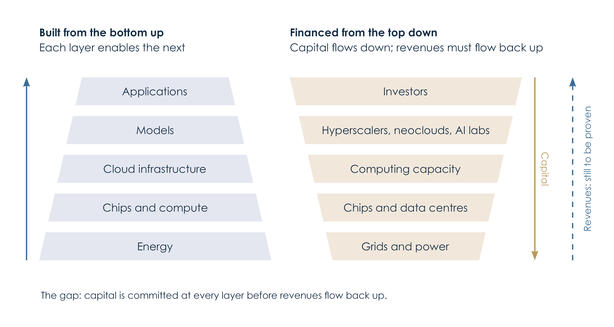
AI infrastructure is built from the bottom up but financed from the top down. Nvidia CEO Jensen Huang describes AI as a pyramid built from energy upwards. When it comes to funding, that pyramid is inverted, creating a gap of hundreds of billions between the capital committed today and the revenues expected tomorrow – the AI bill.
The AI boom is becoming a financing cycle. Infrastructure must be built and paid for before demand, utilisation and revenues are fully established. Success will depend on whether technological progress, physical capacity, adoption and financing can all keep pace with one another.
Infrastructure: building from the bottom up
As head of Nvidia, the chipmaker that powers most of today’s AI models, Jensen Huang has a view across the entire industry. His pyramid, or ‘stack’, rises from energy to chips and compute, cloud infrastructure, models and applications. Each layer enables the next.
But these layers operate on very different timescales. Models and software can improve within months, while semiconductor plants, data centres, transmission networks and power generation take years to deliver.
This mismatch creates scarcity, and when adoption runs ahead of capacity, chipmakers, memory suppliers and data-centre operators can command higher prices. Scarcity, however, also delays projects, leaving capital committed while interest payments accumulate, hardware ages and technology evolves before the infrastructure has earned back its cost. This is where the AI bill begins: costs build up long before revenues arrive.
Investment: an inverted pyramid
The funding chain runs in the opposite direction. Investors provide capital to hyperscalers (the largest cloud providers, such as Microsoft, Amazon and Alphabet), neoclouds (newer specialists that rent out AI computing power) and AI labs, which purchase computing capacity and support investment further down the pyramid in chips, data centres, grids and power generation.
Hyperscalers initially financed the boom from their large cloud, software and advertising cash flows. But as spending rises, external capital is becoming more important. Neoclouds rely more heavily on equity, debt, private credit and leases, while model developers consume vast amounts of compute before proving they can generate sustainable profits.
Suppliers are paid as equipment is delivered and capacity is built. Compute providers are caught in the middle: they own the assets, carry the debt and need sufficient utilisation to earn an adequate return.
Monetisation: cheaper intelligence, larger markets
Eventually, the flow must reverse. Customers pay for AI applications, applications pay for models and inference (the computing power used each time a model answers a request), model companies pay cloud providers, and cloud providers pay for chips, data centres, electricity and financing.
Infrastructure and investment are already operating at scale. Monetisation is the part that remains to be proven. The issue is not whether AI can generate revenues. It already does. The question is whether those revenues will be large enough, arrive quickly enough and carry sufficient margins to justify the capital committed across the pyramid.
Timing will determine who benefits:
These imbalances can only last as long as investors and lenders are willing to fund them. If revenues arrive too slowly or refinancing becomes too expensive, investment will eventually slow, regardless of how powerful the technology becomes.
The challenge is particularly acute for model developers. They must recover enormous training and inference costs just as the price of AI is falling. Yet cheaper intelligence is also what should drive mass adoption. The economics therefore depend on usage rising faster than prices fall.
The AI pyramid can only stand if cheaper intelligence creates demand faster than it destroys pricing power, and if revenues arrive before investors lose patience. Like the sovereign bill, the AI bill will be paid. The question is by whom.
Valentin Bissat, Head of Macro & Asset Allocation at Mirabaud Wealth Management
Next chapter – Portfolio diversification in the age of AI Return to Investment View 2027
