Not left holding the bill: portfolio diversification in the age of AI
AI is increasingly difficult to avoid, but equally difficult to diversify.
AI is increasingly difficult to avoid, but equally difficult to diversify.

In brief
AI’s influence stretches across traditional asset classes. In equity markets, semiconductors are expected to account for 60% of US earnings growth in 2027 despite making up just 19% of the S&P 500 Index. The same investment cycle is spreading into corporate bonds, private credit, private equity and infrastructure.
Arbitrarily capping AI exposure could be costly if the theme continues to dominate growth and market returns. Yet participating without regard to valuation, leverage or profitability would be equally dangerous. The challenge is therefore not whether to hold AI exposure, but where to take it and whether the underlying economics justify the capital being committed.
Equities: distinguish exposure from economics
AI is no longer about sector allocation. It has become a common factor that extends beyond large technology companies to power equipment, industrials, utilities and businesses expected to benefit from AI-led productivity gains. A portfolio may therefore look diversified by sector while remaining dependent on the same investment cycle.
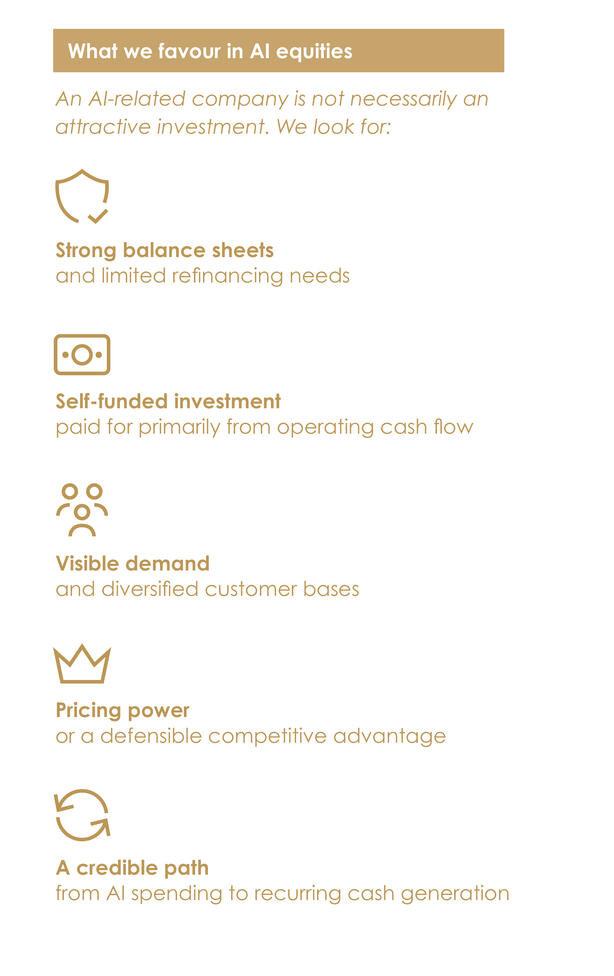
The priority is to distinguish exposure from economics. An AI-related company is not necessarily an attractive investment. The underlying business must still generate an adequate return on the capital committed.
The layers of the AI stack, from chips and power through cloud infrastructure to models and applications, carry very different risks and should not be treated as interchangeable. Chip and power-equipment suppliers may benefit early in the infrastructure phase. Hyperscalers (the largest cloud providers, such as Microsoft, Amazon and Alphabet) have stronger financing bases but face rapidly rising capital requirements. Neoclouds (newer specialists that rent out AI computing power) offer more direct exposure to compute demand, generally with greater leverage. Model developers face falling token prices (the price charged per unit of AI output) and competition from openly available alternatives, while applications offer greater monetisation potential but less visibility.
Equity exposure should remain meaningful, as AI is likely to remain an important source of earnings and market returns. However, the emphasis should be on quality, cash-flow visibility and financing resilience. Even a powerful investment theme can produce disappointing returns if too much future growth is already reflected in valuations.
Fixed income: more yield, more selectivity
AI is also becoming a major theme in fixed income. Companies building and powering the digital economy increasingly rely on corporate bonds, leases, structured vehicles and private credit for funding. The AI investment cycle is therefore spreading across investment-grade credit, high yield and structured finance.
Higher yields improve prospective returns, while rising issuance and capital requirements should also increase dispersion between issuers. This favours active selection over broad credit exposure.
New bond issues from well-capitalised hyperscalers may offer opportunities, as their strong cash flows comfortably cover their debt costs. Among weaker borrowers, however, reported leverage may understate the true debt burden. Leases, purchase commitments, project guarantees and special-purpose vehicles can create debt-like obligations outside the headline balance sheet. For bond investors, that means a company can carry more risk than its headline numbers suggest, with less protection if demand weakens.
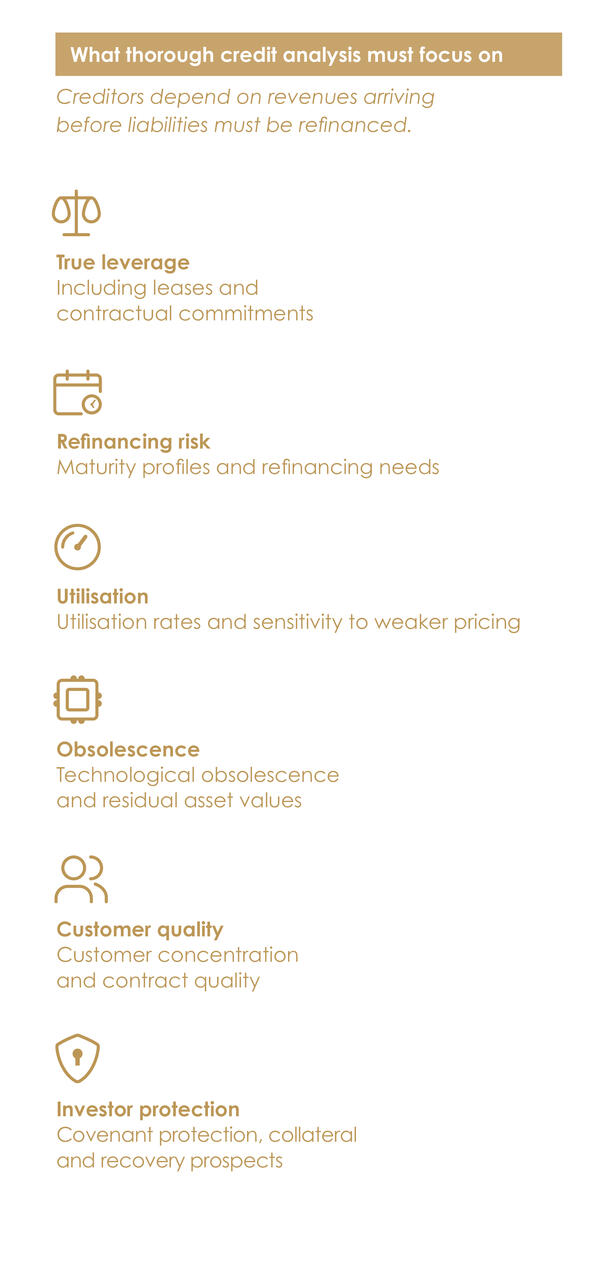
This is particularly important for neoclouds and data centres that rely on a single client. These businesses may serve a fast-growing market, but creditors still depend on revenues arriving before liabilities must be refinanced. Being right about AI in the long run will not help a borrower that runs out of cash in the short run.
Sovereign bonds retain an important role for portfolios, but investors should be selective about how much long-dated exposure they hold. High-quality bonds can provide protection during an AI investment slowdown or broader growth setback. But they may be less effective when yields rise and prices fall because of inflation or concerns about government debt.
The opportunity is therefore not simply more yield, but more selectivity: favouring transparent balance sheets, appropriate maturities and adequate compensation for the risks that capacity goes unused, equipment becomes outdated or debt proves hard to refinance.
Real assets, private markets and FX
Real assets and private markets provide additional exposure to AI, but not necessarily greater diversification. Infrastructure funds, private equity and private credit may hold different instruments, yet remain tied to the same capital-spending cycle, customers and demand assumptions as public equities and bonds. Less frequent valuations can delay the recognition of these common risks, rather than eliminate them.
With so much of a portfolio potentially tied to the same AI cycle, it is important to hold assets that behave differently. Gold, for example, can protect against fiscal deterioration, geopolitical shocks and declining confidence in financial assets.
Currency exposure also deserves attention. Strong US investment and capital inflows may support the dollar, but large allocations to US equities, credit and private markets can leave portfolios with greater dollar exposure than headline weights suggest. Hedging decisions should therefore reflect the portfolio’s total economic exposure rather than the domicile of individual securities.
True diversification comes from holding assets with different cash-flow drivers and responses to shocks, not from accessing the same AI cycle through several investment vehicles.
Valentin Bissat, Head of Macro & Asset Allocation at Mirabaud Wealth Management
