My Switzerland | Monthly Swiss Market Outlook – July 2026
Each month, My Switzerland provides Mirabaud's latest analysis of the Swiss economy, monetary policy and financial markets. From growth and inflation to equity and fixed income markets, our experts examine the key developments shaping the investment environment and what they could mean for investors. Whether you are monitoring market trends or seeking deeper insights into the Swiss economy, My Switzerland offers a concise overview of the factors driving the months ahead.

SWISS ECONOMIC OUTLOOK
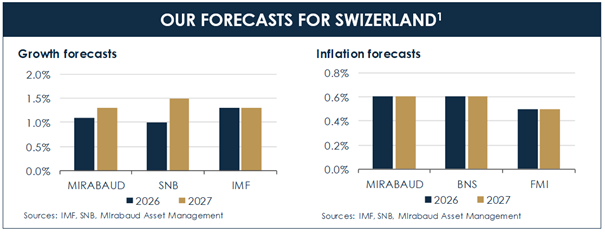
Stagflation risks now appear weaker, in a context marked by the decline in oil prices. The normalization of the geopolitical environment remains bumpy but should help restore the confidence of economic agents if it continues. In Europe, the business climate in June already signals an improvement in activity, from which the Swiss economy should also benefit given its high degree of openness. Indeed, survey indicators in Switzerland confirm this trend. The manufacturing PMI remains in expansion territory, and the production component remains well oriented. On the services side, the PMI reached its highest level since March 2022, driven by a clear improvement in order books, confirming a strengthening of domestic demand. In parallel, the KOF economic barometer shows a significant recovery in the outlook. In this context, the central scenario remains one of positive but contained growth, slightly above 1%, provided that geopolitical tensions continue to ease.
MONETARY POLICY AND THE FRANC
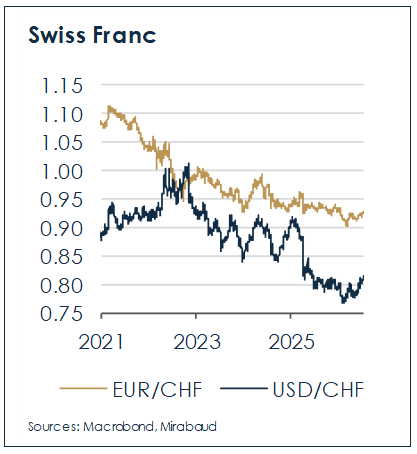
The Swiss National Bank (SNB) kept its key rate unchanged in June, a decision consistent with inflation that remains particularly moderate. Indeed, the latter remained stable in June, at 0.5%, confirming the absence of widespread inflationary pressures. Domestic components are rising moderately, while imported prices remain contained, helping to keep inflation well below the 1% mark. In this context, the central bank continues to consider that medium-term inflation prospects have changed little and retains comfortable room for maneuver before considering a new adjustment of its policy. On the other hand, upward pressures on the franc have eased somewhat: the Swiss franc remained above 0.80 against the dollar during the quarter. The rise in rates in the euro zone as well as the upward revision of US monetary policy expectations limit the risks of the franc appreciating. A status quo of the SNB over the coming quarters seems likely, while inflation remains under control and tensions on the currency appear less pronounced than at the start of the year.
SWISS EQUITY MARKET
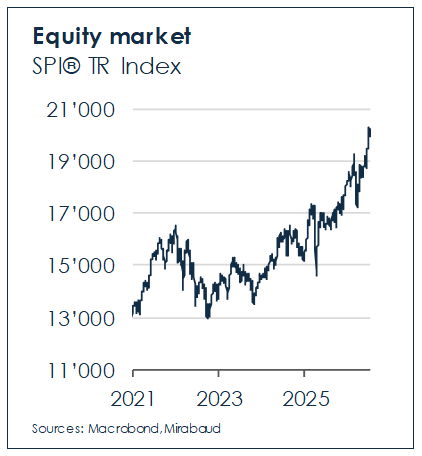
After falling more sharply than its developed peers following the escalation of the conflict in the Middle East in March, the Swiss equity market rebounded strongly in the second quarter. The Swiss Performance Index (SPI® Total Return) thus rose by more than 12% over the period, marking one of its best performances in several years. The rebound accelerated from May onwards, as fears of a lasting disruption to global energy supplies eased. The gradual pullback in oil prices after their peak, combined with prospects of de-escalation in the region, fostered a marked return of risk appetite. At the same time, the resilience of the global economy and investors’ persistent enthusiasm for artificial intelligence-related themes continued to support risk assets. In this context, the stocks most sensitive to the economic cycle largely drove the rise of the Swiss market, such as the consumer discretionary, industrial and technology sectors, while defensive sectors posted more moderate gains.
SWISS BOND MARKET
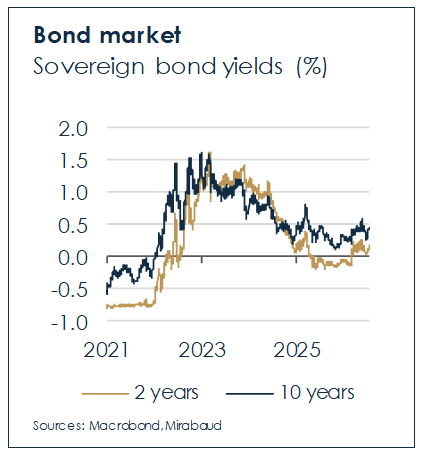
Bond markets continued to evolve in a volatile environment, marked by fluctuations in energy prices and inflation expectations. The rise in oil price until the end of April led to a widespread increase in sovereign yields, which Switzerland did not escape. This trend, however, quickly reversed from May onwards under the effect of the pullback in energy prices and hopes of de-escalation in the Middle East. The 10-year sovereign bond yield thus ultimately declined, moving from 0.35% to 0.28% over the quarter2. This easing was also supported by the SNB maintaining the status quo, in a context where domestic inflation remained contained despite energy tensions.
1 Forecasts are hypothetical in nature and are not a guarantee of future results
2 Source: BNS
Looking for deeper insights? Download the full My Switzerland report or explore our approach to investing in Switzerland.
Related Insights
Stay Informed
Subscribe to our newsletter for the latest insights and market perspectives from our experts.
